
Among the most bizarre medical conditions known to science is the lithopedion, often referred to as the “stone baby.”
This extraordinary occurrence happens in extremely rare ectopic pregnancies and has puzzled doctors for centuries.
In typical pregnancies, the fetus develops safely within the uterus.
However, in abdominal ectopic pregnancies, the fertilized egg implants in the abdominal cavity outside the reproductive organs, leading to high risks for both mother and child.
When the fetus unfortunately perishes in such an environment and the mother’s body is unable to naturally expel or reabsorb the tissue, a unique biological response is triggered to protect her health.
The body encases the dead fetus in layers of calcium, calcifying its tissues and turning it into a hardened mass.
This process prevents potential infections and inflammation that could prove life-threatening.
Women who experience this can unknowingly carry the stone baby for many years, even decades.
There are reports of lithopedions being retained for 40 years or longer without causing significant symptoms.

A notable case involved an 82-year-old woman from Colombia who sought medical attention due to persistent abdominal pain.
What doctors found was astonishing: a calcified fetus that had been inside her for over 40 years.
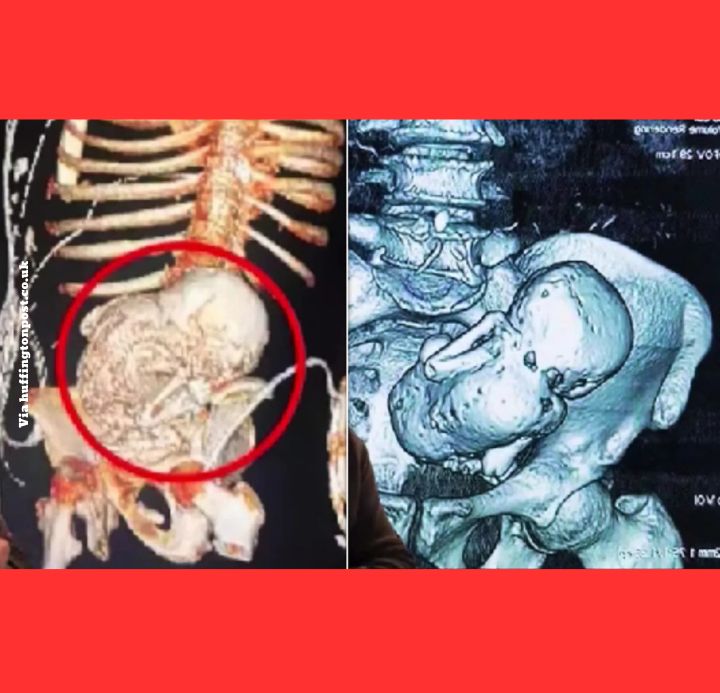
Discovered through an X-ray examination, the four-pound lithopedion had remained dormant in her abdomen since the failed pregnancy.
The woman had lived with it unknowingly for most of her adult life.

Similar discoveries frequently happen by chance.
Many lithopedions are detected incidentally when elderly patients receive X-rays or scans for other medical conditions, revealing the calcified remains.
Despite the intrigue surrounding these cases, lithopedion is exceptionally uncommon.
Medical records document fewer than 350 instances worldwide, making it one of the rarest phenomena in obstetrics.
These images highlight the eerie yet fascinating preservation of fetal bones through calcification.
These cases serve as a testament to the resilience and adaptability of the human body.
They also highlight how modern diagnostic tools like imaging technology continue to uncover secrets of the past, advancing our understanding of reproductive medicine and human physiology.